This article contains screenshot and information about the plot of these games and it might ruin your experience if you didn’t play them yet.
The onboarding of Quantic Dream games
This article compares and analyzes the onboarding, tutorial, and introduction phases of three Quantic Dream games I loved playing.
Case Study
September 1, 2020
Fahrenheit: Indigo Prophecy
Released in: 2005
Platforms: PlayStation 2, Xbox 360, Microsoft Windows
Platforms: PlayStation 2, Xbox 360, Microsoft Windows
Heavy Rain
Released in: 2010
Platforms: PlayStation 3, PlayStation 4, Microsoft Windows
Platforms: PlayStation 3, PlayStation 4, Microsoft Windows
Detroit: Become Human
Released in: 2018
Platforms: PlayStation 4, Microsoft Windows
Platforms: PlayStation 4, Microsoft Windows
Spoiler alert!
Fahrenheit
Intro:
1. The player’s character commits a murder
The game literally starts by throwing the player in a situation which he can't control by committing an apparently random murder in a dining restaurant.
2. A policeman is about to discover the body
The situation escalates quickly as the player is making aware that a policeman is inside the restaurant and is going to discover the murder pretty soon.



The game succeeds in introducing the game mechanics and to present both the story and the game genre to the player in an engaging and exciting way.
Police officer presence function: Create urge in the player
Doing certain actions over others affects the mental status of the character
UX Elements
Tutorial elements highlight
Fahrenheit
Positive onboarding
This game introduction is very well done User Experience wise: it has all the elements to introduce the player to the game mechanics and at the same time to engage the player with the story by involving their emotions as early as the gameplay starts.
Heavy Rain Intro:
1. The player’s character wakes up in his house
The game starts by presenting the protagonist in his house waking up in the morning.
2. Domestic tasks are assigned to the player
The game proceeds in explaining to the player how the mechanics work by leading them to do some simple ordinary tasks.

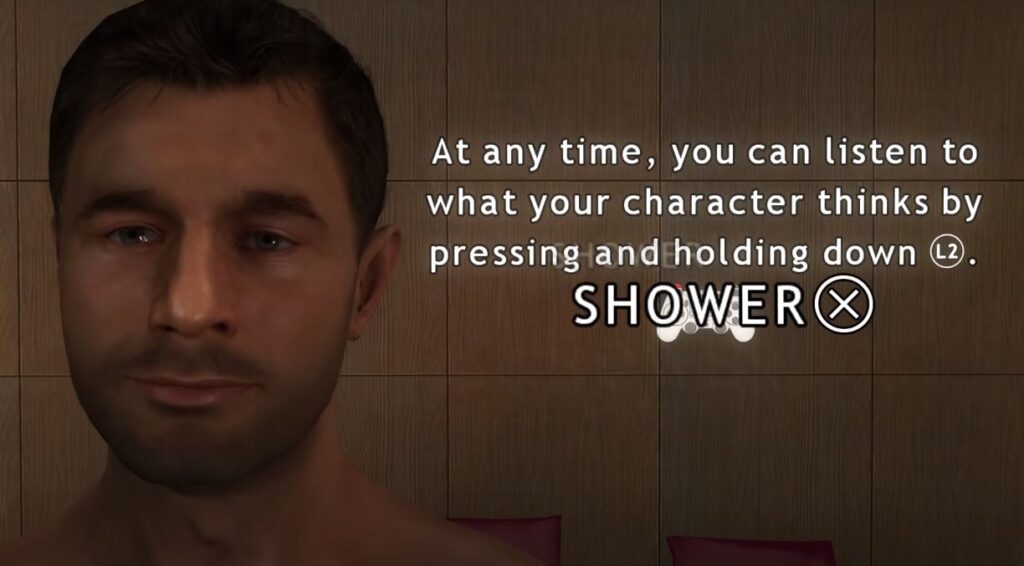

The game takes too long to introduce the story to the player that they are stuck in this limbo doing random tasks waiting for something to finally happen.
There's no real goal set for the player apart from placing dishes on a table or reading a book.
The actual story doesn't start before at least 40 minutes of play time.
UX Elements
Tutorial elements highlight
Heavy Rain
Negative experience
I feel the choice here was to make sure everybody was well aware of the game mechanics before starting to play the actual content, and the game succeeds in that, but meanwhile worrying about mechanics the emotional aspect to engage the player is completely lost doing boring tasks. That might have a negative impact on some players that are not necessarily big fans of the genre.
Detroit Intro:
1. Player needs to deal with a stressful situation
The player is immediately facing a life/death situation: a child is being held by an android that became violent. By playing an Android policeman, the player's task is to desist the kidnapper to jump from the roof with the girl.
2. Collect evidence to gain more knowledge
By analyzing the evidences on the crime scene, the player gets more knowledge about what happened and they get rewarded with extra dialog option at the time to deal with the kidnapper and more possibilities to succeed with the mission.



I completely felt the change here: the tutorial’s structure goes back to the Fahrenheit idea of giving the player an immediate problem to solve.
The next step is clearly written in an overlay menu triggered by a controller button.
Examining clues actually gives you more knowledge about facts, and so you get more dialogue options.
UX Elements
Tutorial elements highlight:
Detroit: Become Human
Positive experience
This game’s tutorial doesn’t feel like a tutorial at all and that is his main strength. The story is immediately engaging and the game mechanics are introduced so well that the player immediately understands what he’s doing and why. This game rewards with extra options and more information the curiosity and the analysis of the clues so it feels natural to search for them.
Thanks for reading my UX article.
I love Quantic Dream games and I’m looking forward to play more games like the ones analyzed in this UX case study.
Disclaimer: I did not work on these games or for Quantic Dreams; this analysis is from a customer’s perspective. All images in this article are property of Quantic Dreams.